You know your child is bright. You've watched them light up over the things they love — and you've watched the same child fall apart over a worksheet, a transition, a word said the wrong way. There's a reason for that, it isn't your parenting, and it can be built. We'll show you how, from your own living room.
See It For Yourself — Free 3-Minute Screener Three tests you can run on your kitchen floor tonight. Zero commitment.A 20-minute assignment turns into an exhausting 2-hour crying session.
Extreme emotional dysregulation and tantrums when turning off devices.
Inability to sit still, follow multi-step directions, or sustain attention.
Acting out and behavioral challenges that traditional discipline doesn't fix.
Shrinking in group settings, fearing judgment, or struggling to read social cues.
Aggressive resistance and arguments over basic daily chores or transitions.
Six different problems. One thing underneath all of them.
You've tried the charts, the consequences, the tutor, the patience you didn't have left. And when none of it stuck, the quiet conclusion was that it must be you. It isn't. Every one of those tools is built for a child who won't. Yours is a child who, right now, can't — and that's a completely different thing.
The brain develops in layers. Balance, coordination, eye control, reflex integration — that base is supposed to become automatic, running quietly underneath everything else. When it hasn't finished, your child has to work at things other kids do without thinking: holding themselves upright, tracking a line of text, staying settled in a loud room. That effort comes straight out of the attention they have left for everything else.
That's not a discipline problem. It's a foundation that's still being built. And a foundation is something you can build together.
Read the full science →Nobody knows your child the way you do. You're there for the mornings, the homework hour, the meltdown at 6:40. That isn't a burden the program works around — it's the single greatest advantage your child has, and no one has ever shown you how to use it. We will.
See how the program works →

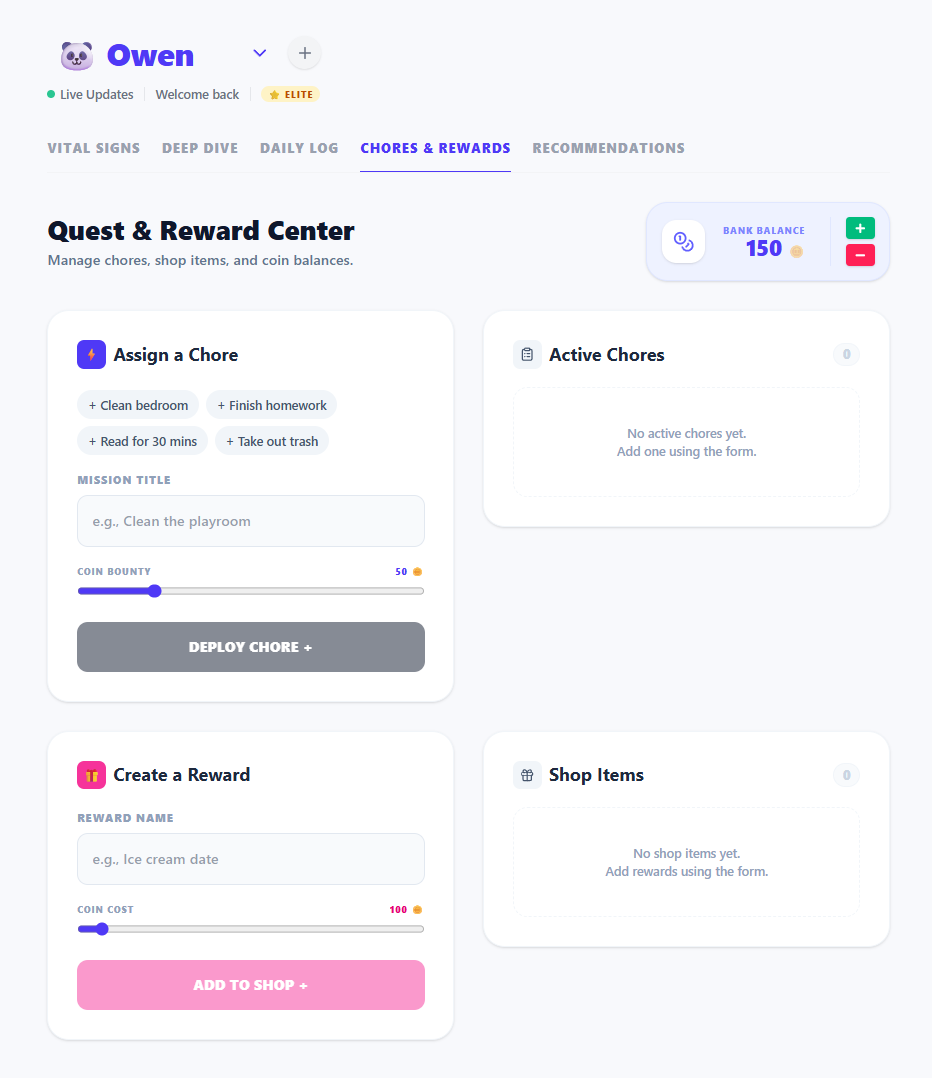
The daily cognitive block runs in our NeuralKids app — adaptive games targeting working memory, attention, and impulse control, wrapped in a chores-and-rewards economy you control.
See inside the app →The hardest part of any program is the stretch where you're doing the work and can't yet tell if it's doing anything. We built the app so you never have to wonder.
Every game your child plays, every exercise you check off, every evening log — it builds into a picture of attention, working memory, processing speed, and regulation that sharpens week by week.
The app connects what you log at night to how the day went. When sleep and screens are trending the wrong way, it tells you a hard day is likely — before it happens, so you can lower the demands instead of bracing for the fight.
Nothing about your child's progress is hidden from you or from them. Your coach walks into every call already knowing the week — so the time goes to what to do next, not catching up.
At week eight and week sixteen, the same screen is run again and scored the same way. Progress is measured, not hoped for.
Three short tests you can do tonight, on your kitchen floor, in about three minutes. They'll show you something most parents have never been shown — and give you a clear place to start.
Take the Free 3-Minute Screener Zero commitment.